Skip to content

Robot Learning · Manipulation · Embodied AI

Hanlong Li

Also goes by Miles

Portrait of Hanlong Li

I study how robots learn manipulation skills that work on real hardware and generalize across tasks and embodiments.

M.Eng. student, Institute of Science Tokyo
Advisor: Prof. Kazuhiro Nakadai
B.S. in Computer Science, Georgia Institute of Technology
Graduated with High Honor, 2024
Research Engineer Intern, AIRoA
Real-robot VLA and RL research and engineering

I am applying to PhD programs in robotics and machine learning for Fall 2027.

01

Publications

My name is highlighted. * denotes equal contribution.

Google Scholar

Some papers are not listed yet. A few manuscripts currently under review will be added here once they are public.

Papers & preprints

  1. AIRoA 2026Technical report

    AIRoA-0: Long-Horizon, Precise, Cross-Embodiment Manipulation from Handheld Data

    Y.-H. Wu, K. Ota, Hanlong Li, H. Yuasa, J. Wang, K. Ikeuchi, K. Chiyoma, M. Sugiura, M. Takahashi, M. Tateno, N. Kanazawa, N. Scianca, P. Khrapchenkov, S. Otsubo, T. Ohkawa, T. Okubo, T. Matsushima, Y. Noguchi, Y. Shin, Z. Zhong

    Technical report, AIRoA, 2026.

  2. arXiv 2026Preprint

    Paraphrase Consensus Is Not Self-Consistency: Instruction Reliance and Robustness in VLA Policies

    Hanlong Li, S. Tan, T. Ashizawa, B. Yen, K. Nakadai

    arXiv preprint, 2026.Under review at ACL Rolling Review (NAACL 2027 cycle)

  3. CoRL-W 2026Workshop

    YUBI-STAG: Contact and Semantic-Rich Alignment for VLAs via Automated Video-Language Grounding

    M. Tateno, T. Ohkawa, Y.-H. Wu, Hanlong Li, T. Matsushima, Y. Sato, K. Ota

    The UMI Arena Workshop at the Conference on Robot Learning (CoRL), 2026.Accepted

    Selected for spotlight presentation.

  4. arXiv 2026Preprint

    AMBIT: Anticipatory Multimodal Body Recruitment for Bimanual Tracking on a Humanoid

    Hanlong Li, S. Tan, T. Ashizawa, B. Yen, K. Nakadai

    arXiv preprint, 2026.Under review at ICRA 2027

  5. IROS 2026Conference

    The Talking Robot: Distortion-Robust Acoustic Models for Robot-Robot Communication

    Hanlong Li, K. Kamalahasan, J. Li, K. Nakadai, S. Kousik

    IEEE/RSJ International Conference on Intelligent Robots and Systems (IROS), 2026.

  6. IMECE 2026Conference

    Toward Bio-Agentic Visual Communication and Control: Implicit Semantic Manifolds and Invariant State Estimation

    B. Starbuck*, Hanlong Li*, B. Bras

    ASME International Mechanical Engineering Congress and Exposition (IMECE), 2026.Accepted

  7. ECCV-W 2026Workshop

    Spectral Optimal Transport for Dynamics-Aware Sign Language Generation

    N. Khan, B. Wu, R. Shi, Hanlong Li, B. Yen, C. T. Ishi, K. Nakadai

    European Conference on Computer Vision (ECCV), MoCha Workshop, 2026.

  8. Biomimetics 2025Journal

    A Concept for Bio-Agentic Visual Communication: Bridging Swarm Intelligence with Biological Analogues

    B. Starbuck, Hanlong Li, B. Cochran, M. Weissburg, B. Bras

    Biomimetics, 10(9):605, 2025.

    Co-corresponding author.

Patent applications

  • US 2026Patent app.

    Biologically Inspired Active Visual Communication System and Method

    B. Bras, M. Weissburg, B. Cochran, Hanlong Li, B. Starbuck

    U.S. Patent Application Publication US 2026/0127397 A1, 2026.

02

Research

Selected projects, described by the problem, the approach, and what I did.

Current work: Robot learning on real hardware

How learned policies turn into reliable motion on real robots: VLA execution, evaluation and robustness, and whole-body planning on a humanoid.

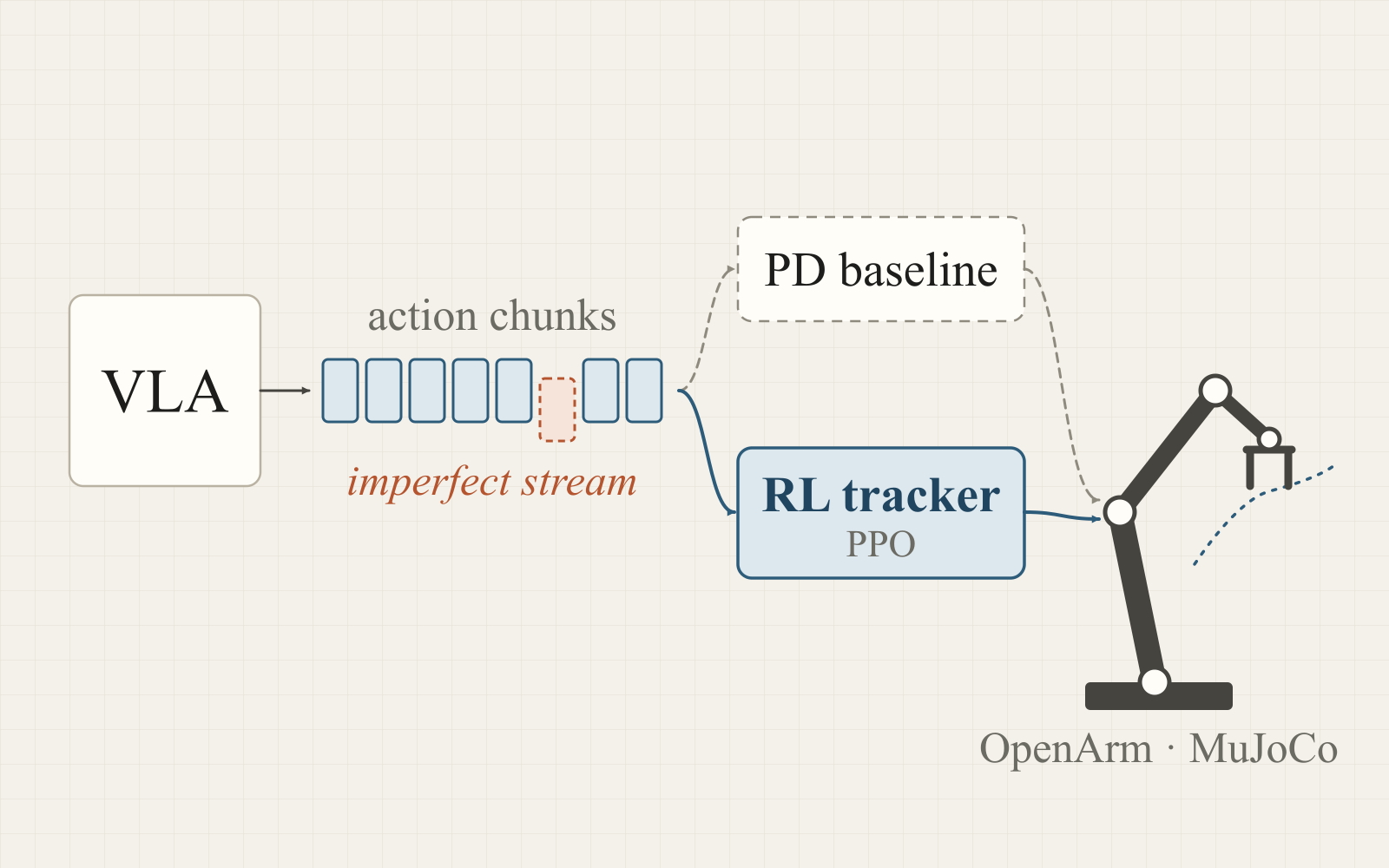
Schematic: a VLA policy emits action chunks with one late command (an imperfect stream); the chunks go either to a PD baseline or to a PPO-trained RL tracker that drives a simulated OpenArm along the commanded path.
Schematic overview.

AIRoA 2026 – presentOngoing

Can a learned controller execute VLA actions more faithfully than PD control?

VLA policies output short chunks of future actions, but what the robot actually does depends on the low-level controller that tracks them, typically a hand-tuned PD loop. I train PPO tracking policies with domain randomization in a simulated OpenArm benchmark (MuJoCo/MJLab) and compare them against matched PD baselines, including when the command stream is imperfect.

Key result
Preliminary: ~2.4% tracking error with RL vs. ~4.6% with PD, a ~48% relative decrease (pending experimental verification)
My role
  • Initiated and lead the project, mentored by Nicola Scianca.
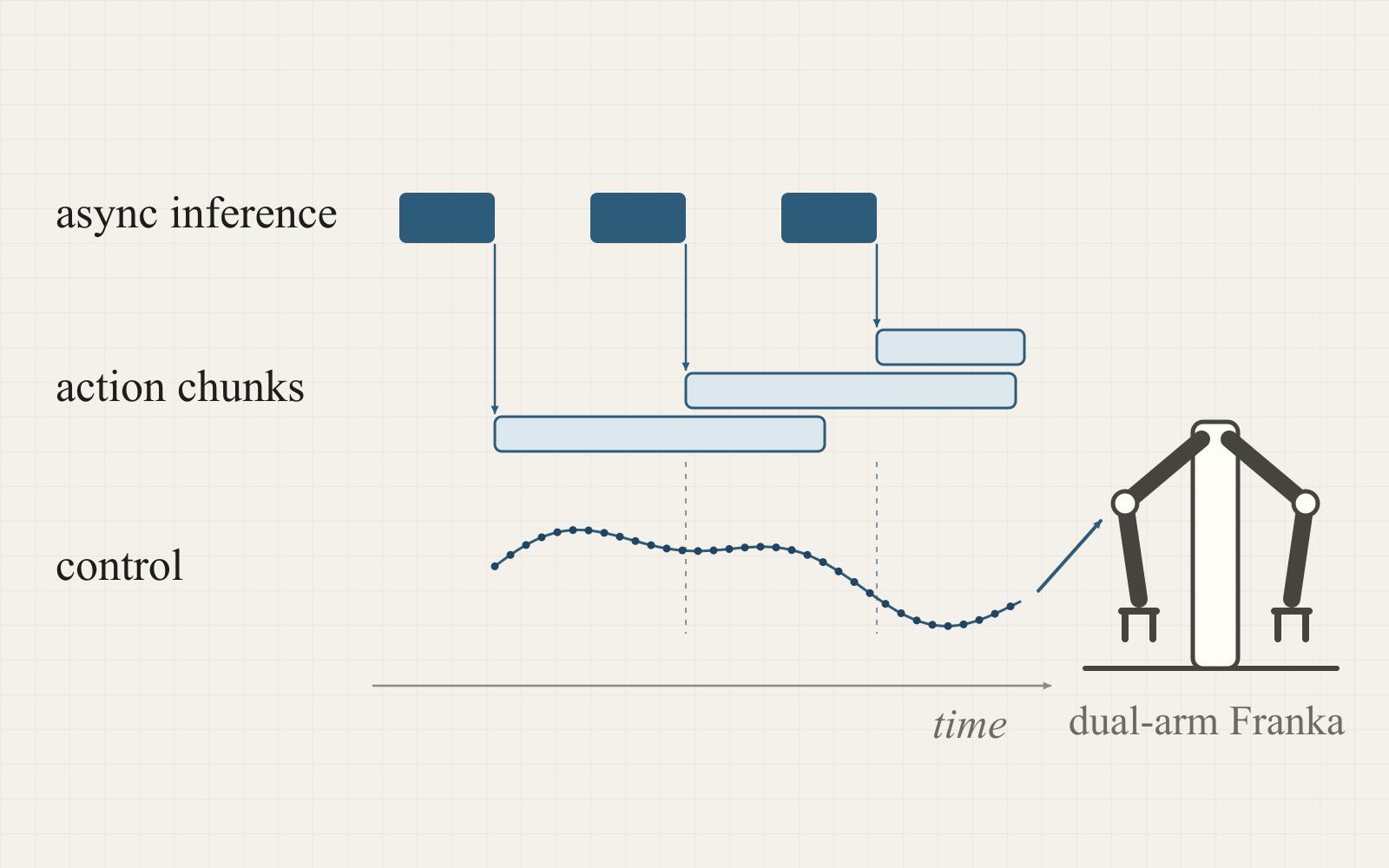
Schematic timeline: asynchronous VLA inference calls produce time-aligned, overlapping action chunks that are interpolated into a high-rate control signal for a dual-arm Franka platform.
Schematic overview.

AIRoA 2026 – presentAIRoA 2026 (jump to citation)Ongoing

Making VLA policies work on a real dual-arm robot

Deploying VLA policies on real hardware raises questions that offline benchmarks hide: how inference and control stay in step in real time, how actions should be represented for a given robot, and how to evaluate policy behavior systematically. I work on these with the AIRoA team on a dual-arm Franka platform.

My role
  • Designed and hardware-validated the real-time execution stack: asynchronous, time-aligned action-chunk re-inference with interpolated high-frequency control.
  • Led 60 real-robot evaluation sessions (177 recorded trial segments): protocols, metrics, and trajectory recording and analysis tools.
  • Designed and hardware-tested action-representation adaptation, and carried out the real-robot evaluations on the bimanual Franka for AIRoA-0.
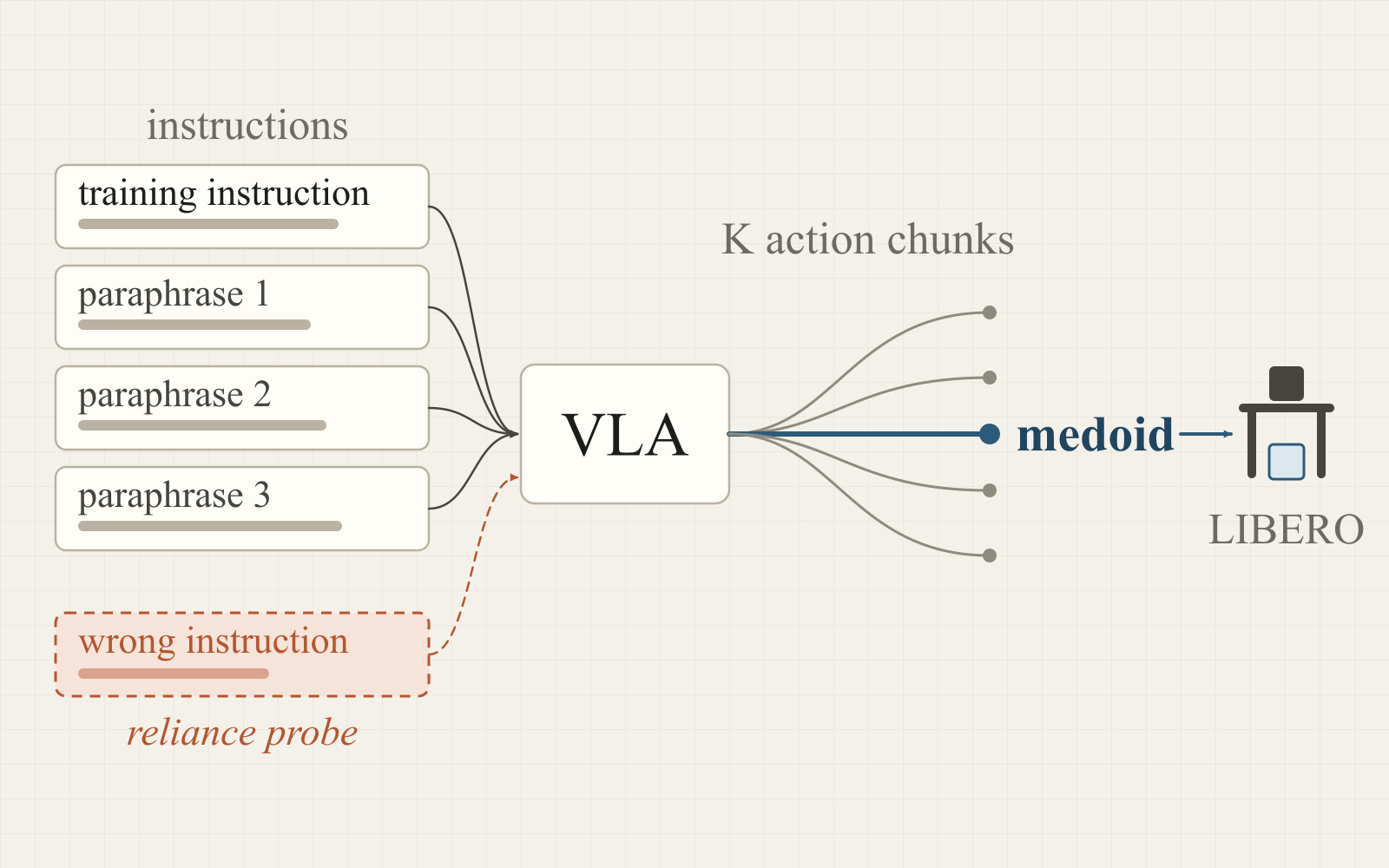
Schematic: the training instruction and three paraphrases, plus a wrong-instruction reliance probe, feed a VLA policy; its K action chunks are aggregated by taking the medoid, which is executed on LIBERO.
Schematic overview.

Nakadai Lab, Institute of Science Tokyo 2026arXiv 2026 (jump to citation)

How much do VLA policies depend on the exact wording of their instruction?

VLA policies fine-tuned on LIBERO are trained and evaluated on the same ten instruction strings. This work measures what rewording the instruction costs, tests whether test-time paraphrase consensus recovers it, and introduces a wrong-instruction probe of how much a policy’s success depends on the instruction at all, across three policies and four suites.

Key result
Rewording the instruction costs base OpenVLA 38.0 points; paraphrase consensus does not recover it
My role
  • First author. Built the evaluation harness and paraphrase pipeline, and ran the consensus, probe and LoRA post-training experiments.
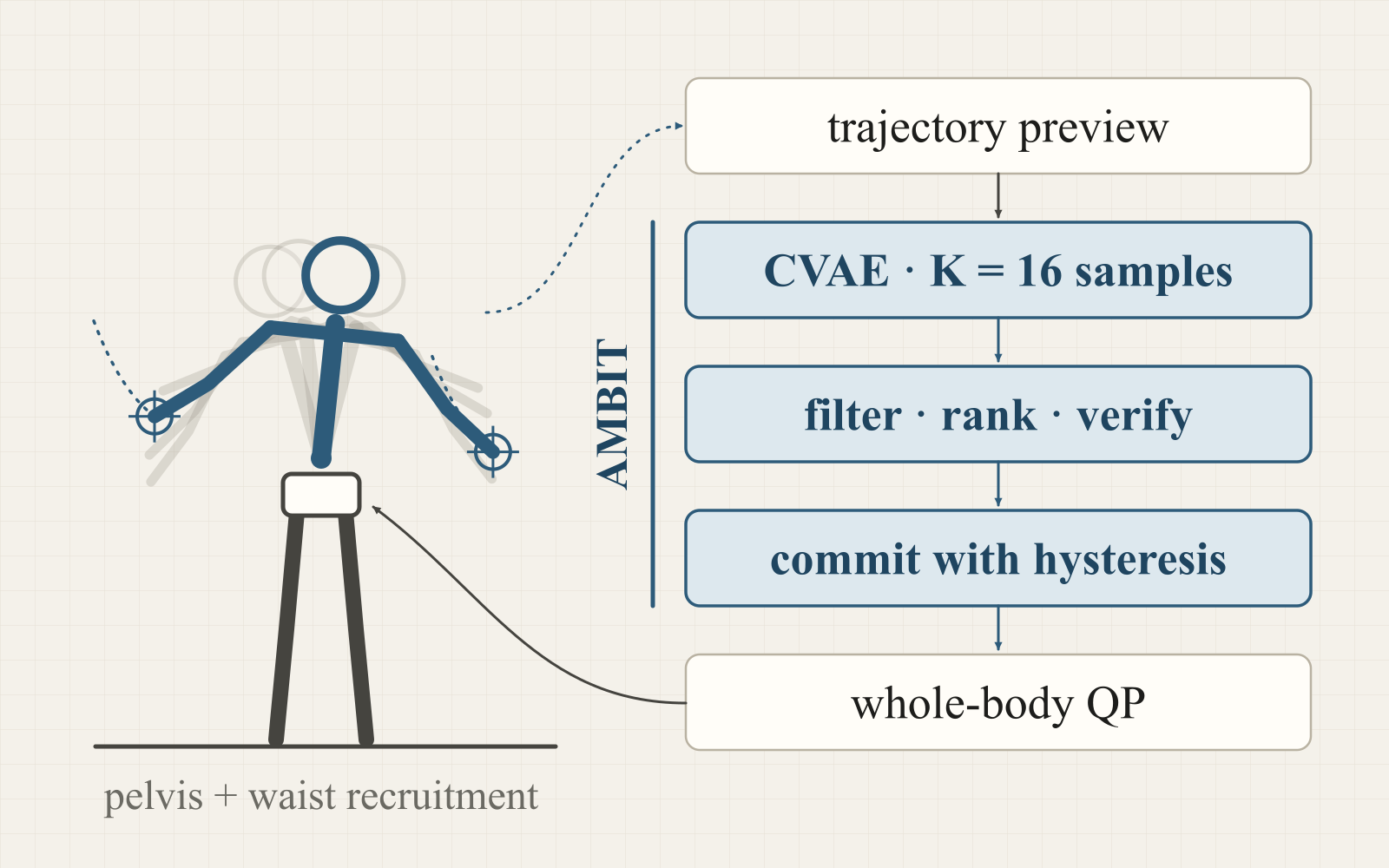
Schematic: a humanoid with faint alternative upper-body recruitment strategies and one committed strategy reaching two hand targets; beside it the AMBIT pipeline from trajectory preview through CVAE sampling (K = 16), filter-rank-verify selection and commit with hysteresis to a whole-body QP.
Schematic overview.

Nakadai Lab, Institute of Science Tokyo 2025 – 2026arXiv 2026 (jump to citation)

A humanoid that plans ahead which body parts to use for two-handed tracking

Tracking targets with both hands on a humanoid is a whole-body problem: depending on where the targets go, the pelvis and waist may need to be recruited. AMBIT decides this in anticipation rather than reacting after the fact: a CVAE proposes diverse whole-body strategies, a non-learned selector filters, ranks and verifies them, and a whole-body differential-IK QP tracks the chosen one.

Key result
85% success vs. 74% for a reactive tracker on 160 held-out feasible simulation episodes
My role
  • First author. Led the project from problem formulation to method design, simulation evaluation and hardware demonstrations on a Unitree R1 humanoid (carried out with external support).

Earlier work: Learned multimodal communication

Robot-to-robot communication through sound and vision. These projects are not manipulation research, but they are where I learned to build learning systems that hold up under real-world noise.

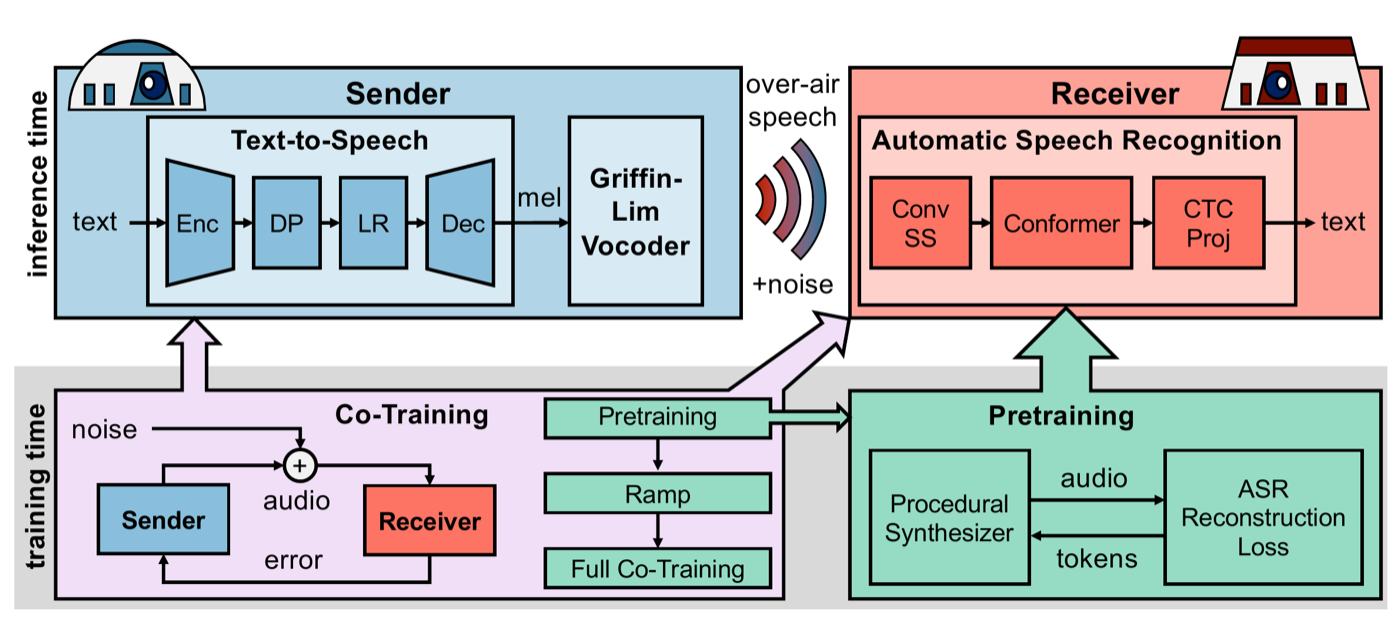
System diagram. Inference time: a sender robot runs text-to-speech (encoder, duration predictor, length regulator, decoder) and a Griffin-Lim vocoder, and speaks over the air with added noise to a receiver robot running automatic speech recognition (convolutional subsampling, Conformer, CTC projection). Training time: the receiver is pretrained with a procedural synthesizer and ASR reconstruction loss, then sender and receiver are co-trained through added noise in three phases: pretraining, ramp and full co-training.
System overview from the paper: a TTS sender and a Conformer-CTC receiver talk over a noisy over-air channel, co-trained in three phases after receiver pretraining.

Demo: two laptops, as “Robot Alpha” and “Robot Beta”, exchange messages over the air.

Robot Danger Lab, Georgia Tech 2024 – 2025IROS 2026 (jump to citation)

Robots that talk to each other over sound, even in heavy noise

Robots sharing a space can talk to each other over sound, but real acoustic channels are noisy and distorting. This work learns the channel end to end: a FastSpeech-style transmitter turns messages into audio, a Conformer-CTC receiver decodes them, and a noise-aware training curriculum keeps the pair reliable as conditions degrade.

Key result
8.3% character error rate at 0 dB SNR, from a 2.1M-parameter codec with under 13 ms CPU inference
My role
  • First author. Developed the end-to-end transmitter–receiver system and the noise-aware training curriculum, and ran the evaluation.
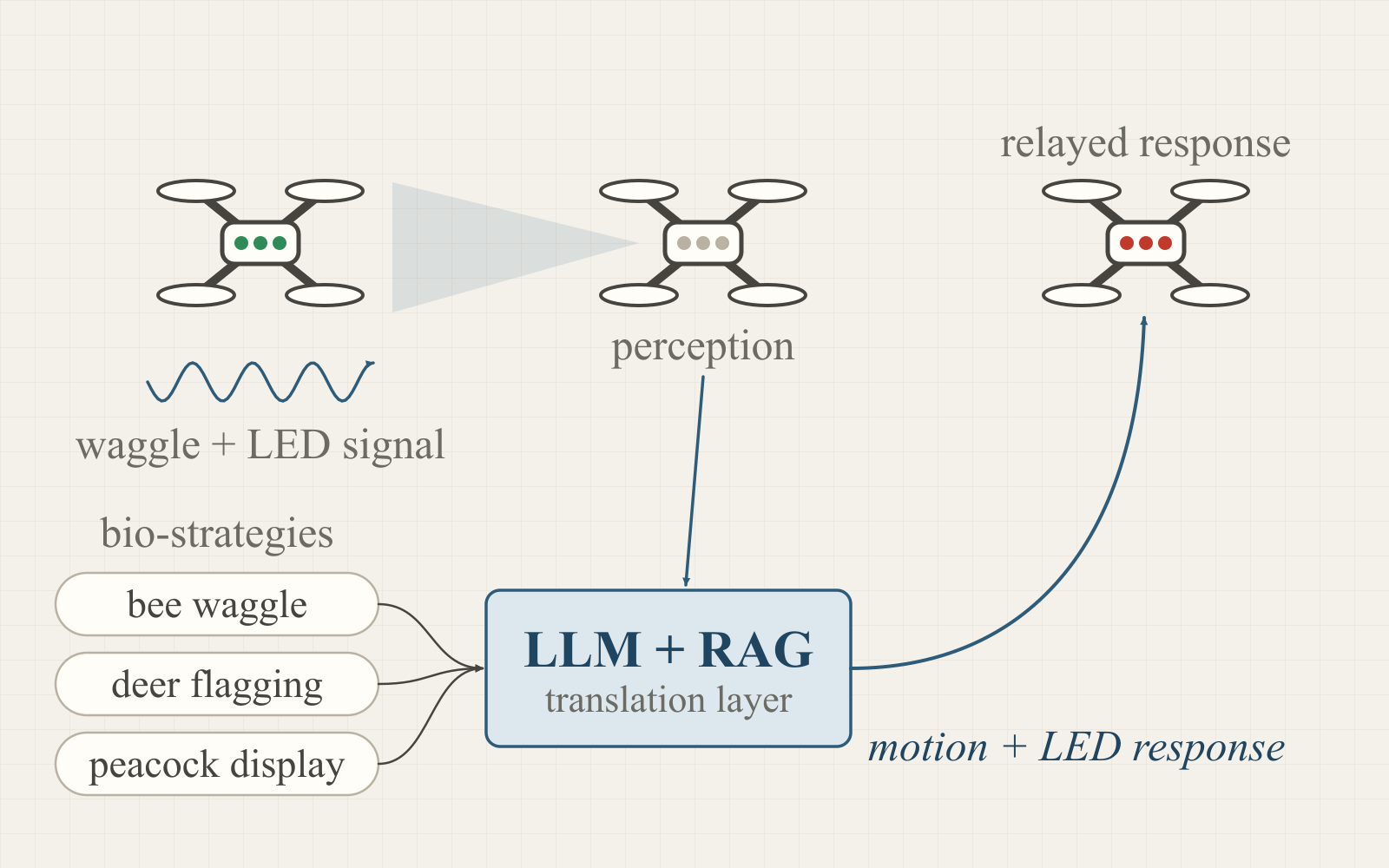
Schematic: one UAV signals with a waggle maneuver and green LEDs, a second UAV perceives it, an LLM + RAG translation layer informed by bee, deer and peacock bio-strategies generates a motion and LED response, and a third UAV relays it with red LEDs.
Schematic overview.

Sustainable Design & Manufacturing Lab, Georgia Tech 2023 – 2025IMECE 2026 (jump to citation)Biomimetics 2025 (jump to citation)U.S. Patent App. 2026 (jump to citation)

Robots that communicate the way animals do: through motion and light

Many animals coordinate through visible signals such as movement patterns and light. This project develops biologically inspired visual communication for robots: UAVs signal through motion and LED patterns, perceive the signals of others, and respond through an LLM/RAG-based module that generates symbolic responses, forming a low-bandwidth communication channel grounded in perception.

My role
  • Co-developed the UAV visual communication system and built its ROS and computer-vision components, including an AprilTag/YOLO perception pipeline. Co-author on the journal and conference papers and co-inventor on the U.S. patent application.

03

Experience & education

Research

  1. –

    AIRoA

    Research Engineer Intern · Tokyo, Japan

    Mentors: Nicola Scianca and Yueh-Hua (Kris) WuProjects: RL for VLA execution, Real-world VLA

  2. –

    Nakadai Laboratory

    Graduate Researcher · Institute of Science Tokyo · Tokyo, Japan

    Advisor: Prof. Kazuhiro NakadaiProjects: AMBIT, Instruction reliance in VLAs

  3. –

    Robot Danger Lab

    Visiting Researcher · Georgia Institute of Technology

    Advisor: Prof. Shreyas KousikProject: The Talking Robot

  4. –

    Sustainable Design & Manufacturing Lab

    Undergraduate Researcher, then Part-Time Researcher · Georgia Institute of Technology

    Advisor: Prof. Bert BrasProject: Bio-agentic visual communication

Education

  1. 2025 – 2027 (expected)

    Institute of Science Tokyo

    M.Eng., Systems and Control Engineering

    Advisor: Prof. Kazuhiro Nakadai

  2. 2024

    Georgia Institute of Technology

    B.S., Computer Science

    Threads: Intelligence & People · Graduated with High Honor · Dean’s List

Industry

Before moving into full-time robotics research, I worked as a full-time software engineer (2024–2025), building full-stack features for AI-powered administrator tools and integrating machine-learning outputs into production web and iOS applications.

Teaching

  • Teaching Assistant, Global PBL Foundation, Institute of Science Tokyo2025

04

About

From multimodal perception and communication to real-world robot learning.

Research trajectory

  1. 2023 – 2025

    Bio-inspired visual communication

    SDM Lab, Georgia Tech

    Perception and planning for multi-robot systems

  2. 2024 – 2025

    Machine learning for robot-to-robot interaction

    Robot Danger Lab, Georgia Tech

    End-to-end learning that is robust to real-world noise

  3. 2025 – 2026

    Generative whole-body planning and control

    Nakadai Lab, Science Tokyo

    Embodiment-aware action generation on a humanoid

  4. 2026 – now

    Real-world VLA & RL control

    AIRoA

    Learned policies executed and evaluated on real robots

  5. PhD · Fall 2027

    Generalizable manipulation learning

    Next

    RL + IL for skills that transfer across tasks and embodiments

At AIRoA I work with VLA policies on real robots. Running and analyzing real-robot evaluations showed me how much of a policy’s behavior is decided after the model outputs an action: in how action chunks are timed, represented and tracked by the controller. That observation is what led me to start a project on reinforcement learning for the low-level execution of VLA actions.

In my PhD I want to work on manipulation learning that generalizes. I am interested in combining reinforcement and imitation learning so that skills carry over across tasks, objects and embodiments, with the embodiment treated as part of the learning problem rather than an afterthought. I care about careful real-world evaluation, and I enjoy research that goes all the way from a question to a robot that does the thing.

Research interests

  • Robot manipulation learning
  • Reinforcement & imitation learning
  • Vision-language-action models
  • Embodiment-aware learning & control
  • Multimodal robotic systems